Skip to main content Skip to footer

Have your say on the Draft Annual Plan 2026/2027

Westland District Council is seeking community feedback on the Draft Annual Plan 2026/2027.

The Annual Plan sets out Council’s proposed budget, services, and priorities for the coming year. It reflects a review of Year 2 of the Long Term Plan 2025–2034 in response to rising costs and changing conditions.

Key information

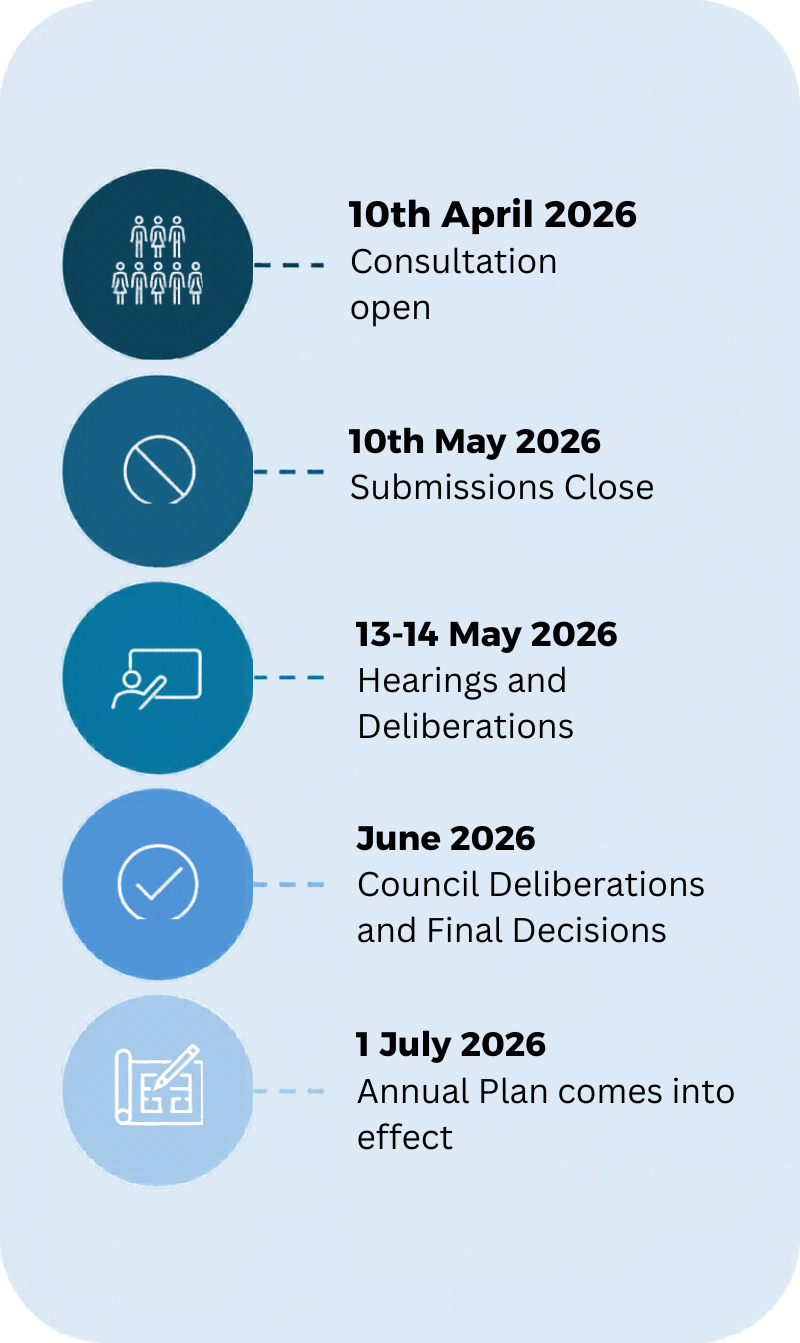
•    Consultation open: 10 April to 10 May 2026
•    Proposed average rates increase 6%
•    Anyone can make a submission
•    Final decisions will be made in June 2026

What’s being proposed

The Draft Annual Plan includes a number of proposed changes for community feedback. These are intended to balance affordability, service delivery, and long-term sustainability.

Proposals include:
•    A proposed average rates increase of 6%
•    Changes to some services and operating hours
•    A review of fees and charges
•    Proposed changes to the way some reserves and depreciation funding are used
•    A number of options where Council is seeking community feedback before making final decisions

No decisions have been made
Council is consulting before making final decisions on the Draft Annual Plan.
Community feedback will be considered by elected members as part of the decision-making process before the final Annual Plan is adopted.

What can and can’t change?
The Long-Term Plan (2025–2034) sets Council’s long-term direction, including major projects and service levels.
Once adopted, it limits how much can change.
The Annual Plan focuses on smaller adjustments, such as service levels, fees, and how services are delivered, to respond to current conditions and community feedback.
This means consultation is about shaping these adjustments, rather than making significant changes to Council’s overall direction.

Key consultation topics

We are seeking feedback on the following proposals:
•    Remittance of rate penalties
•    Pool operating hours
•    Museum operating hours
•    Library operating hours
•    isite operating hours
•    Library reserves
•    Heritage Park depreciation
•    Review of fees and charges

How to have your say

Submissions are open from 10 April to 10 May 2026.
You can make a submission in the way that suits you best.

Anyone can make a submission — you do not need to be a ratepayer.

You can read or download the consultation documents below.


•   Read the Draft Annual Plan
•   Read the Consultation Document
•   Download printable submission form
Our online submission form is below
Hard copies are also available at Council offices and libraries.

What happens next? 

Once submissions close, Council will review and consider all feedback received.
Submitters who have asked to speak to their submission will be invited to attend a hearing. Council will then deliberate and make final decisions before adopting the Annual Plan in June 2026.

Need help?
If you would like help understanding the Draft Annual Plan or making a submission, please contact us.
Phone: 0800 474 834
Email: Consult@westlanddc.govt.nz 

Annual Plan 2026/2027 Submissions Form

I would like to speak to Council about my submission


Frequently Asked Questions (FAQs)

What is the Annual Plan?

The Annual Plan sets out Council’s budget, services, and key activities for the coming year. It is a review of Year 2 of the Long Term Plan 2025–2034, updated to reflect current conditions and priorities.

Why are we consulting on the Annual Plan?

     Council is consulting because there are proposed changes to budgets, services, and rates that differ from what was originally planned in the Long-Term Plan. We are seeking community feedback before making final decisions. 

What is being proposed?
The Draft Annual Plan includes:
o A proposed average rates increase of 6% 
o Changes to some service levels (including operating hours) 
o Adjustments to fees and charges 
o A focus on maintaining essential services while managing costs 

Why can’t Council make bigger changes?
The Long-Term Plan sets Council’s long-term direction, including major projects and service levels.Once adopted, there are limits to how much can change.
The Annual Plan allows Council to make smaller adjustments in response to current conditions, but not major changes to overall direction. Community feedback is still important, as it helps shape these decisions.

Across all of these proposals, Council is seeking feedback on how to balance cost, service levels, and long-term sustainability.


Why are rates increasing?
Costs have increased since the Long-Term Plan was developed, including inflation, interest rates, and the cost of delivering services and maintaining infrastructure. The proposed increase reflects the need to balance affordability with maintaining core services.

Is the rates increase higher than planned?
No. The proposed average increase of 6% is lower than what was originally forecast in the Long-Term Plan.

What is Council doing to manage costs?
Council has reviewed budgets and is proposing changes to improve efficiency, including adjusting service levels where appropriate and carefully managing operational costs.

What service changes are proposed?
Some changes are proposed to operating hours and how certain services are delivered. These changes are intended to better align services with demand and reduce costs while maintaining access.

Will services be reduced?
Some service levels may change, but the focus is on maintaining core services while managing costs responsibly.

Why are service levels being reviewed?
Council is reviewing service levels to ensure they remain:
o Affordable 
o Sustainable 
o Aligned with community use and demand

How can I have my say?
You can make a submission:
o Online via the Council website 
o By completing a written submission form 
o In person at Council offices or libraries 
o By contacting Council for assistance 

Who can make a submission?
Anyone can make a submission — you do not need to be a ratepayer.

When do submissions close?
Submissions close on 4pm 10 May 2026.

What happens to my feedback?
All submissions are considered by elected members before final decisions are made. Submitters also have the opportunity to speak to their submission during public hearings.

Has Council already made its decision?
No. This is a consultation process. Council is seeking feedback before making final decisions in June.

Will my feedback actually make a difference?
Yes. Council is required under the Local Government Act to consider all feedback with an open mind before making decisions.

What if I don’t agree with the proposals?
We encourage you to make a submission and tell us your views. Understanding different perspectives is an important part of the decision-making process.

What happens after consultation closes?
o Submissions are reviewed and analysed 
o Public hearings are held (if you wish to speak) 
o Council deliberates and makes final decisions 
o The final Annual Plan is adopted in June 

Where can I find the Annual Plan and Consultation Document?
o On the Council website 
o At Council offices and libraries (hard copies available) 

What if I need help understanding the document?
Council staff are available to help. You can:
o Call or visit the Council office 
o Ask questions at the public Q&A session 
o Speak with your local councillor

What is being proposed?
Council is reviewing how it applies penalties to overdue rates and whether penalties should continue to be refunded in certain circumstances.

What are the options?
Option 1 – Stop refunding penalties (preferred)
o Once a penalty is applied, it remains payable 
o Provides additional revenue and reduces administrative processes 

Option 2 – Status quo
o Continue to refund penalties if rates are paid within 7 days of notice 


Why is this being considered?
o To create a more consistent and transparent approach 
o To encourage timely payment of rates 
o To reduce administrative effort

What is the impact?
Option 1 would result in a small overall reduction in rates (approx. 0.29%) 
Option 2 has no financial impact 

What is Council seeking feedback on?
o Whether penalties should remain once applied 
o The balance between fairness, simplicity, and affordability 

What is being proposed?
Council is reviewing whether user groups should operate outside standard pool opening hours.

What are the options?
Option 1 – All use within standard hours (preferred)
o No use outside normal operating hours 
o Reduces staffing costs 

Option 2 – Status quo
o Continue allowing use outside standard hours 

Why is this being considered?
o To reduce unplanned staffing costs 
o To better align operating hours with resourcing 

What is the impact?
Option 1 delivers a small saving (approx. 0.02% rates) 
Option 2 has no financial impact 

What is Council seeking feedback on?
o Whether extended access is worth the additional cost 
o The importance of flexibility for user groups 

What is being proposed?
Council is reviewing museum operating hours to better reflect seasonal demand.

What are the options?
Option 1 – Reduce hours (preferred)
o Maintain access during peak periods 
o Moderate cost savings 

Option 2 – Further reduce hours
o Greater cost savings 
o Reduced access 

Option 3 – Status quo
o No change to current hours 

What is the impact?
o Option 1: approx. 0.18% rates reduction 
o Option 2: approx. 0.21% rates reduction 
o Option 3: no change 

What is Council seeking feedback on?
o The balance between access and cost 
o Acceptability of reduced hours 

What is being proposed?
Council is reviewing library hours to align with usage and reduce costs.

What are the options?
Option 1 – Reduce hours (preferred)
o Minor weekday and weekend reductions 

Option 2 – Further reduce hours
o Greater reductions and savings 

Option 3 – Status quo
o Maintain current hours 

What is the impact?
Option 1: approx. 0.14% rates reduction 
Option 2: approx. 0.17% rates reduction 
Option 3: no change 

What is Council seeking feedback on?
o Acceptable level of access 
o Trade-off between cost savings and service availability 

What is being proposed?
Council is reviewing isite hours to better align with demand and operating costs.

What are the options?
Option 1 – Reduce hours (preferred)
o Moderate reductions 
o Maintains core service 

Option 2 – Further reduce hours
o Greater savings 
o Reduced access 

Option 3 – Status quo
o Maintain current hours 

What is the impact?
o Option 1: approx. 0.12% rates reduction 
o Option 2: approx. 0.19% rates reduction 
o Option 3: no change 

What is Council seeking feedback on?
o Level of visitor servicing expected 
o Balance between tourism support and cost 

What is being proposed?
Council is reviewing whether to continue funding depreciation into the library reserve.

What are the options?
Option 1 – Do not fund depreciation (preferred)
o Use existing reserves 
o Reduce short-term costs 

Option 2 – Status quo
o Continue funding reserve annually 

What is the impact?
o Option 1: approx. 0.31% rates reduction 
o Option 2: no change 

What is Council seeking feedback on?
o Use of existing reserves vs future planning 
o Short-term affordability vs long-term funding 

What is being proposed?
Council is reviewing whether it should continue funding depreciation for Heritage Park buildings.

What are the options?
Option 1 – Stop funding depreciation (preferred)
o Do not set aside funds for replacement 
o Heritage Park responsible for replacement 

Option 2 – Status quo
o Continue funding depreciation 

What is the impact?
o Option 1: approx. 0.53% rates reduction 
o Option 2: no change 

What is Council seeking feedback on?
o Whether Council should fund future replacement 
o Appropriate allocation of responsibility 

What is being proposed?
Council is proposing adjustments to some fees and charges to better reflect the cost of providing services.

Why are fees being reviewed?
Costs of delivering services have increased 
Fees are periodically reviewed to ensure fairness and cost recovery 

What are the options?
Option 1 – Increase fees and charges (proposed approach)
o Align fees more closely with actual costs 
o Reduce reliance on rates 

Option 2 – Keep fees unchanged
o Maintain current fee levels 
o Greater cost burden remains on ratepayers 

What are the trade-offs?
o Increasing fees shifts more cost to users of services 
o Keeping fees unchanged means higher costs are shared across all ratepayers 

What is Council seeking feedback on?
o Whether fees should better reflect actual costs 
o  The balance between user-pays and ratepayer funding 

What is being proposed?
Council is proposing an average rates increase of 6%.

Proposed rates increase (6%)
o Reflects current costs and proposed changes 
o Includes cost management and efficiency measures 

Higher or lower rates scenarios
o Higher rates could maintain or expand services 
o Lower rates would require further reductions in services or increased use of reserves 

Why is a rates increase needed?
o Increased costs (inflation, interest rates, infrastructure) 
o Maintaining essential services and compliance requirements 

What is Council trying to achieve?
o Balance affordability with service delivery 
o Avoid deferring costs that create future pressure 

What is Council seeking feedback on?
o Whether the proposed increase strikes the right balance 
o Community priorities around services vs cost